
Driverless Taxis Have Arrived in London. What Happens if They Crash?
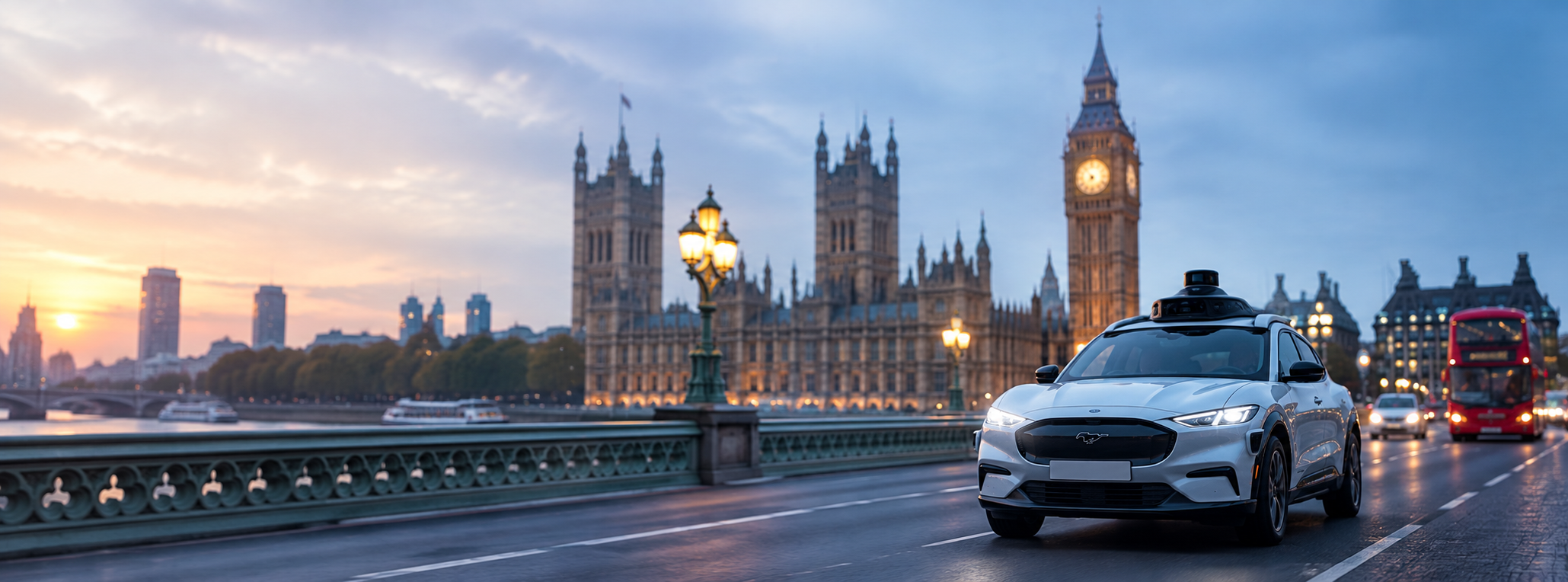
Imagine booking an Uber and finding that the car arriving to collect you can drive itself.
It's no longer just a possibility.
On 3 September 2026, Uber and British autonomous vehicle company Wayve launched the UK's first publicly available autonomous ride-hailing service in London.
The initial fleet uses electric Ford Mustang Mach-E vehicles fitted with Wayve's automated driving technology and surrounding sensors.
Passengers booking an UberX, Uber Electric or Uber Comfort journey may be matched with one of these vehicles at no extra cost. They can accept the autonomous ride or choose a conventional Uber instead.
But there's an important detail.
These taxis aren't completely driverless.
Every journey still has a trained, Transport for London-licensed private hire driver on board to supervise the technology and take control when necessary.
It's a significant step towards a future where cars could complete journeys without human drivers. However, it also raises some interesting questions.
Are autonomous vehicles safer? Who's responsible when the technology makes a mistake? And could removing the driver eventually make car insurance cheaper?
Let's look at what London's new taxis could mean for motorists and the insurance industry.
How do London's autonomous taxis actually work?
The vehicles use Wayve's artificial intelligence-based driving system to interpret their surroundings and make driving decisions.
Cameras and other sensors gather information about nearby traffic, road markings, pedestrians and obstacles.
The automated driving system uses that information to help the vehicle navigate its route.
Wayve's technology takes a different approach from systems that rely heavily on detailed maps and individually programmed rules for every possible driving situation.
Its AI is designed to learn from driving experience and apply that learning in different environments.
London provides a demanding place to demonstrate those capabilities.
The capital's roads feature busy junctions, narrow streets, cyclists, pedestrians, roadworks and drivers making last-minute decisions.
An autonomous vehicle must recognise these situations and respond safely.
And while the technology is designed to perform the driving task, a human supervisor remains ready to intervene throughout the current Uber journeys.
Can passengers choose whether to use an autonomous taxi?
Yes.
If you're matched with a Wayve vehicle through the Uber app, you can accept the ride or switch to a conventional Uber before it arrives.
The autonomous journey costs no more than the equivalent conventional booking.
At launch, the service operates across London, excluding airports, and uses a relatively small fleet that Uber expects to expand gradually.
The potential benefits could extend beyond convenience.
Autonomous taxis may eventually improve access to transport for people who cannot drive, including some older and disabled passengers.
They could also offer another option for people living in towns and cities who don't want to own a car.
However, these benefits will depend on service availability, accessibility, affordability and how reliably the technology performs.
Are driverless cars safer than human drivers?
That's one of the biggest questions surrounding autonomous driving.
The technology has the potential to reduce certain types of road accidents, but it would be premature to conclude that every autonomous vehicle is safer than a human driver.
Different systems operate under different conditions.
A vehicle tested on wide American roads may face very different challenges when navigating narrow British streets in heavy rain.
There are nevertheless reasons to investigate the technology's safety potential.
Government analysis found that human error was recorded as a contributing factor in 88% of road collisions in Great Britain in 2020.
Automated vehicles could potentially reduce some risks associated with tiredness, distraction and impaired driving.
A computer doesn't become impatient in traffic, check its phone or decide to drive after drinking.
However, removing these human behaviours doesn't eliminate every risk.
What could go wrong with an autonomous vehicle?
Automated driving introduces different technical challenges.
For example:
Cameras and sensors may be affected by poor visibility or adverse weather.
Software could misinterpret an unusual road situation.
A mechanical or electronic component could fail.
Cybersecurity incidents could affect connected vehicle systems.
Other road users may behave unpredictably.
A vehicle also needs to recognise when it cannot safely continue operating within its authorised conditions.
These risks mean that autonomous driving systems require thorough testing, ongoing monitoring and clear safety requirements.
What safety standards apply in the UK?
The Automated Vehicles Act 2024 establishes a framework for authorising self-driving vehicles in Great Britain.
The legislation requires safety principles designed to ensure that authorised automated vehicles achieve a level of safety equivalent to, or higher than, that of careful and competent human drivers.
The principles must also aim to improve overall road safety as authorised automated vehicles are introduced.
However, meeting these standards will require reliable evidence.
Regulators will need to understand how individual systems perform in different environments, weather conditions and traffic situations.
For insurers, this evidence will also be important when assessing risk.
Who is responsible if a driverless car causes an accident?
This is where autonomous driving becomes particularly interesting for motor insurance.
With a conventional car, an insurer will usually investigate the actions of the drivers involved.
Was someone speeding? Did they fail to give way? Were they distracted?
But when software is performing the driving task, responsibility becomes more complicated.
An accident might involve a faulty sensor, software error, inadequate maintenance or another road user's actions.
The manufacturer, software developer, vehicle operator and other organisations could all have different responsibilities.
For someone injured in a collision, working out exactly where the fault originated could otherwise become a lengthy technical investigation.
Fortunately, UK legislation has already started addressing this.
What happens when there's no human driver at all?
London's current Uber and Wayve vehicles still have supervising drivers.
However, future autonomous services could involve cars completing journeys without anyone responsible for driving sitting behind the wheel.
The Automated Vehicles Act 2024 creates a wider framework for this type of operation.
It separates responsibility for the automated driving technology from responsibility for operating and maintaining the vehicle.
There are three important roles to understand.
1. The authorised self-driving entity
Every authorised automated vehicle will need an authorised self-driving entity, known as an ASDE.
This will typically be the manufacturer or developer responsible for the automated driving system.
The organisation will have ongoing responsibilities for ensuring that the technology meets the required safety standards and complies with relevant regulatory obligations.
2. The no-user-in-charge operator
Some vehicles will be authorised to complete entire journeys without anyone needing to take control.
These vehicles will also require a licensed no-user-in-charge operator.
This organisation will be responsible for non-driving tasks, including maintaining roadworthiness and responding to breakdowns or incidents.
The business developing the software and the organisation operating the vehicle may be different companies.
3. The user-in-charge
Some authorised automated vehicles may drive themselves for part of a journey but require a person to take control in certain circumstances.
The legislation introduces the role of a user-in-charge for these vehicles.
When an authorised self-driving feature is engaged and operating within its approved conditions, that person will generally not be responsible for offences arising solely from the way the vehicle drives.
However, they retain responsibilities outside the automated driving task.
They must also respond appropriately if the vehicle issues a valid request to resume control.
This differs from conventional driver-assistance systems, where the driver remains responsible for supervising the vehicle.
When will fully driverless vehicles become more widely available?
The Government is still preparing the secondary legislation and detailed safety requirements needed to implement the Automated Vehicles Act 2024.
The wider implementation programme is working towards 2027, with detailed regulations being developed for the second half of that year.
The availability of individual commercial services will depend on regulatory approval and operators' deployment plans.
For now, London's supervised autonomous taxis represent an intermediate stage rather than completely driverless transport.
How will autonomous vehicles change car insurance?
Automated driving could change how insurers assess risks, investigate accidents and calculate premiums.
The basic need for insurance remains, but determining what caused an accident may become considerably more complicated.
Here are five areas likely to require particular attention.
1. Insurers will need more vehicle data
Imagine two identical-looking vehicles involved in separate collisions.
One was being driven manually. The other had its authorised self-driving system engaged.
That distinction could be central to determining responsibility.
Insurers may need access to information that answers questions such as:
Was the automated driving system active when the collision occurred?
Was the vehicle operating within its authorised roads, speeds and weather conditions?
Did the system request that a human resume control?
Was sufficient warning provided?
Had the required software and security updates been installed?
Was there a mechanical fault, damaged sensor or cybersecurity incident?
Without reliable information, claims could become complicated disputes between insurers, manufacturers, software developers and vehicle operators.
Access to this data will need to be secure and appropriately standardised.
It must also respect privacy and protect commercially sensitive information.
2. Repairs could become more expensive
Modern vehicles already contain cameras, radar and sensors that make some repairs more complicated.
Autonomous vehicles could take this further.
Even a minor collision may damage equipment responsible for identifying surrounding vehicles, pedestrians or road markings.
Replacing a bumper or repairing a body panel may not be enough.
Sensors and associated systems could need specialist inspection, recalibration and testing before the vehicle can safely return to the road.
A car might look perfectly repaired while still having a problem with the technology responsible for interpreting its surroundings.
These requirements could affect repair costs, repair times and the availability of suitably equipped repairers.
For insurers, fewer collisions wouldn't necessarily mean proportionately lower claims costs if individual repairs became more expensive.
3. Insurance pricing could change
Traditional car insurance takes account of information such as a driver's age, experience, claims history, vehicle and location.
For vehicles operating fully autonomously, some of these factors may become less relevant while the automated system is driving.
Instead, insurers may increasingly consider:
The safety record of the automated driving system.
The roads and conditions in which it can operate.
Software and update history.
Maintenance and repair arrangements.
The organisations responsible for the technology.
Two outwardly similar cars could present different risks because they use different software, sensors or authorised driving features.
This may also change the information required when arranging insurance.
Accurately identifying a vehicle's specification and capabilities will remain important.
4. Cybersecurity will become more significant
Autonomous vehicles rely on software and connected technology.
That introduces risks that differ from those associated with conventional vehicles.
A software defect could potentially affect multiple cars using the same system.
Cybersecurity incidents might also disrupt vehicle operation or compromise sensitive information.
Insurers will need to understand how these risks are managed and how responsibility is allocated when something goes wrong.
Manufacturers and software developers will also have ongoing obligations relating to the safety and security of their systems.
5. Drivers must understand what their car can actually do
This is particularly important for everyday motorists.
Many modern cars already feature adaptive cruise control, automatic emergency braking and lane-keeping assistance.
However, the presence of these systems doesn't necessarily make a vehicle legally authorised to drive itself.
Most conventional driver-assistance features require the driver to remain attentive and responsible throughout the journey.
An authorised self-driving system operates under a different legal framework and within specified conditions.
Confusing the two could create dangerous situations and complicate an insurance claim.
Always understand the capabilities and limitations of your vehicle's technology and follow the manufacturer's instructions.
Will driverless cars make insurance cheaper?
It's a question plenty of motorists will want answered.
And the answer?
Possibly. But don't count on it just yet.
If automated driving reduces the number of accidents, that could lower some insurance costs.
However, fewer accidents don't automatically mean cheaper claims.
Autonomous vehicles may contain expensive sensors, cameras and computing systems that require specialist repairs.
Even relatively minor bodywork damage could result in a substantial repair bill.
A defect affecting a widely used software platform could also potentially involve multiple vehicles.
Insurers will need to balance any reduction in accident frequency against repair costs, claim severity and new technology-related risks.
Ultimately, premiums will depend on real-world evidence.
Insurers will want to understand how frequently particular systems are involved in accidents, how serious those accidents are and how much the vehicles cost to repair.
Until enough comparable claims information becomes available, it's too early to know how autonomous driving will affect premiums across the wider market.
Cars Are Changing. Is Your Insurance Up to Date?
From everyday motoring to vehicles with increasingly advanced technology, having suitable car insurance remains important. Explore Motor-Vision's car insurance options and get a quote online today.
